
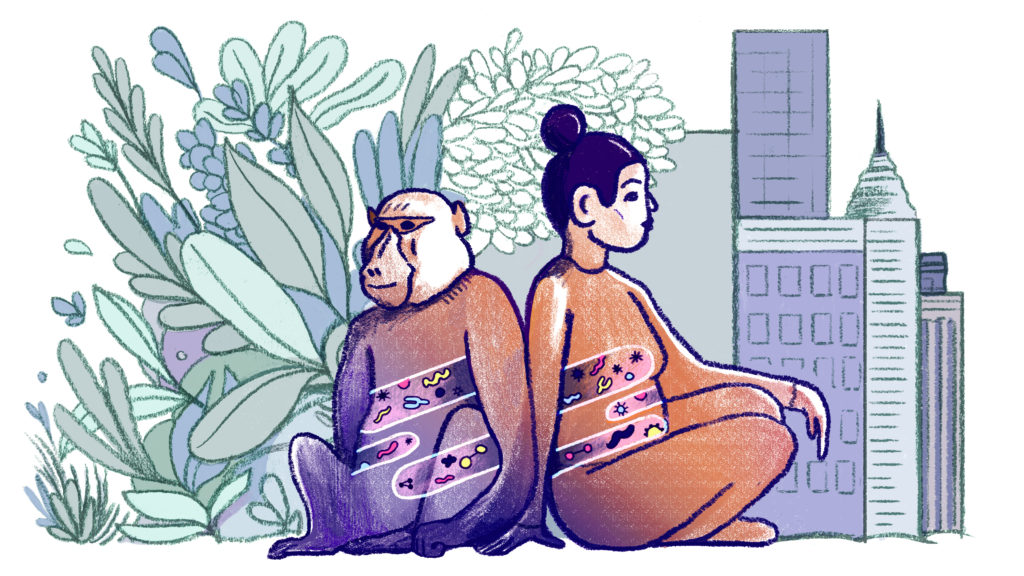
Our research explores how microbes mediate environmental impacts on human and non-human primate biology. We address these questions using health-based, ecological, and evolutionary perspectives, and we apply them to a range of species and populations. Here are a few of the ongoing projects in the lab:
IntBIO: Integrative Wildlife Nutrition: From Molecules and Microbes to Macro-Ecology (NSF-funded)
Collaboration with Jessica Rothman, Erin Vogel, Elizabeth Johnson, Rosemary Braun
For wild animals, food availability varies across space and time. To obtain sufficient nutrients and energy to survive and reproduce, animals must adjust their feeding and nutritional strategies in response to this variation. Most animal feeding ecology research only provides insight into part of an animal’s strategy, but this project aims to provide a more holistic understanding. We are collecting data from five species of primates across seasons in two tropical forests (Kibale National Park, Uganda and Tuanan Biological Research Station, Indonesia). The project will determine the extent to which feeding behavior, nutrient intake, physiology, and microbiome function shift in response to food availability in individual wild, non-human primate species over time (Intra-species Level), compare the relative importance of behavioral, physiological, and microbial strategies for modulating nutrition among sympatric non-human primate species (Inter-species Level), and determine the extent to which non-human primate strategies for modulating nutrition are conserved between forests with different patterns of food availability (Ecosystem Level). Our ultimate goal is to facilitate the development of improved models of primate nutrition that can be used to identify unified principles of nutrition that can be tested and applied across a range of ecological contexts and scales.
Identifying non-human primate models for specific human microbiome traits (NIH funded)
Collaboration with Tom Sharpton
The gut microbiota is increasingly recognized as an important contributor to a range of human physiological processes and is attracting increasing attention as a dynamic area for the development of therapeutics. To realize the potential of the gut microbiome in a therapeutic context, animal models are necessary to generate causal, mechanistic data describing host-microbe interactions. While mice and fish have been critical in generating foundational microbiome data toward this goal, they have key genetic, physiological, and behavioral differences from humans that can interfere with the translation of findings. Non-human primates share many genetic, physiological, and behavioral traits with humans, increasing their translational potential. Although non-human primates are used for research across the NIH, they are currently underutilized in microbiome research and have not been systematically validated as models in this context. Here, we aim to identify the best uses for different non-human primate species in microbiome research. We are generating baseline microbiome and physiological data from humans and five non-human primate species commonly used as biomedical models. These data will allow us to determine which non-human primate species model different taxonomic and functional features of the human gut microbiome and to measure the consistency of host-microbiome interactions across human and non-human primate species. Our efforts hold potential to unlock critical insight about the utility of longstanding non-human primate biomedical models for different aspects of microbiome research and will ultimately help researchers accelerate the translation of microbiome discoveries into clinical settings.
Evolutionary perspectives on the human gut microbiome
Collaboration with Elizabeth Mallott, Hendrik Poinar, Liping Zhao, Gary Wu
Every mammal species has a unique gut microbial fingerprint, but gut microbial traits are also shared among closely-related mammalian species. Understanding these patterns in primates helps us gain key evolutionary insight into the human gut microbiome. This project builds on our prior work showing more gut microbial similarities between humans and cercopithecines than between humans and other apes. We aim to understand the extent to which the human gut microbiome is unique among primates, what traits are shared with other apes, and what traits are shared with other apes. To achieve this goal, we are comparing the overall composition and functional potential of the gut microbiome of multiple human, baboon, and chimpanzee populations. We are also comparing the diversity and identity of butyrate-producing genes using bait enrichment as well as networks of microbial functional guilds using MAGs. Our results will shed important evolutionary insight into specific gut microbial traits and what it means to have a ‘healthy’ human gut microbiome.
Functional impacts of primate gut microbiomes on host physiology
Gut microbes can shape a variety of host physiological traits upon which natural selection can act. As a result, the unique gut microbial fingerprint of each mammal species is likely to have contributed to the evolution of that species. Nevertheless, there are a dearth of empirical data testing how the gut microbiomes of different host species causally shape host biology. This project aims to fill that gap by inoculating germ-free mice with the gut microbiomes of different primate species and assessing physiological differences in the mice. To date, we have generated evidence that the gut microbiome contributes to host interspecific differences in both metabolism and brain function. We are continuing to explore other aspects of physiology as well as mechanisms through which the gut microbiome may be shaping these differences. The results will be transformative for our knowledge of the role of the gut microbiome in host evolution.
Neighborhood Gardens
Collaboration with Ana Aparicio, Terry Horton
We are beginning a project that crosses the subfields of biological and cultural anthropology to analyze the ways in which access to community gardens affects the social and biological health of participants in these spaces. Urban gardens introduce multiple changes in a community – from access to fresh foods (especially fruits and vegetables), spaces in which people interact and where community cohesion and personal connections can be built, cultural and spiritual connections with nature, the potential for organizing or conversations about pressing local issues or politics, and spaces for physical activity and mental restoration. While much research has examined the social, political, and cultural benefits of community green spaces and gardens, there is not yet robust data on the ways in which these spaces can affect mental, physical, and social health of communities following the introduction of community gardens and greenspaces. We are working with urban gardens in the Chicago area to collect biological data describing inflammation, stress, and the microbiome as well as qualitative data describing social cohesion, community belonging, and political organization. Our primary goal is to demonstrate the therapeutic potential of urban gardens, which can be used to garner further support for their creation and maintenance.
The Cebu Study
Collaboration with Thom McDade and Chris Kuzawa
We utilize longitudinal data collected from families living in Cebu, Philippines for over 30 years. Using microbiome and biomarker samples, we are investigating life history patterns, fetal growth rate and birth weight, and physiological dynamics during pregnancy. Learn more about the Cebu Longitudinal Health and Nutrition Survey here.